


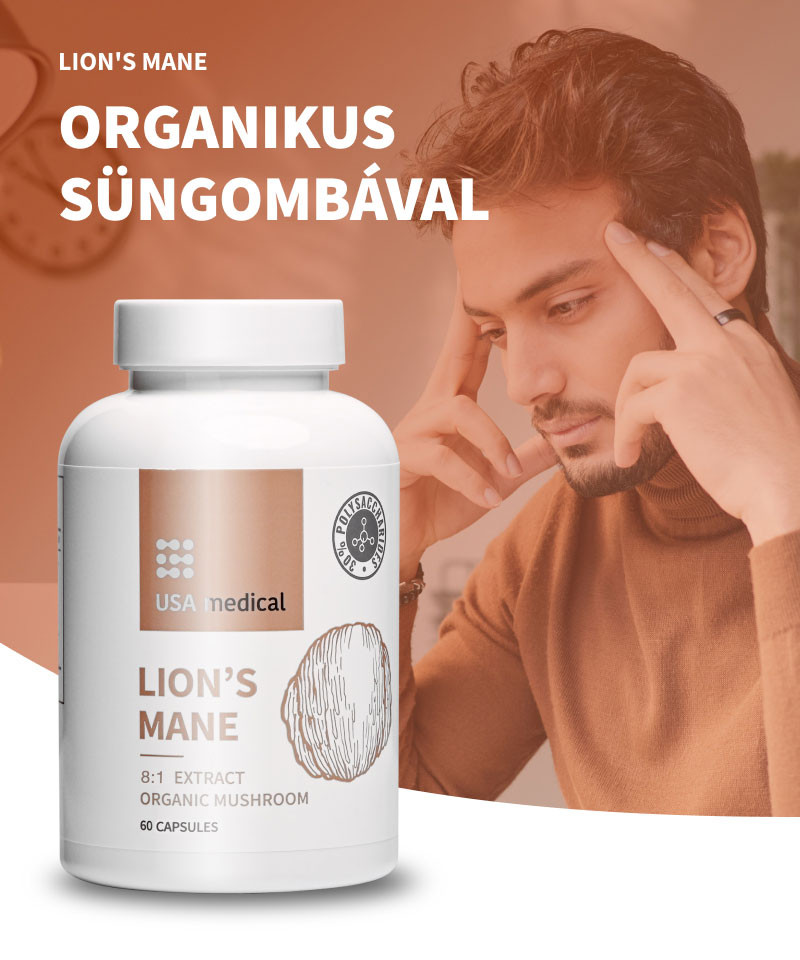
USA medical Lion's Mane Mushroom with Acerola Extract 60 Capsules
| Product number | 5999860001163 |
| Weight | 10 |
| Quantity unit | pc |
Our ORGANIC LION’S MANE capsule contains organic Lion’s Mane extract, which is standardized to more than 30% polysaccharide! And for extra absorption, we added valuable acerola extract!
When creating our product, we put great emphasis on using only the precious extract of the fungus instead of the mushroom powder, thus providing a clean and high-quality dietary supplement for those who are looking for the true essence of the fungus, which contains concentrated polysaccharide active ingredients!
Why is the USA medical ORGANIC LION’S MANE lion’s mane extract capsule completely different from other mushroom products? Because:
It contains only the best of the mushroom! 8:1 ratio of the extract, concentrated active ingredient!
compared to the powder, the extract has a concentration of about 10 times polysaccharide
It is not a powder, but a concentrated extract with more than 30% polysaccharide content!
exclusively made using organic mushrooms
extra fine milling for release of active ingredients and thus excellent absorption
is produced with the most gentle production: the extract is obtained from the mushroom powder exclusively by hot water extraction, without the use of alcohol
with the added acerola, we made it even more effective, as its extract helps the stronger absorption of polysaccharides, and therefore there is no need to use a separate acerola preparation with the mushroom capsule!
does not contain any cereals or forbidden mycelium, the extract is made exclusively from the powdered mushroom body
Unfortunately, there are many mushroom powder products that contain mycelium (root structure) instead of the mushroom body. In addition, these products mainly contain the grain on which the mycelium grows. It is an excess filler with a low content of active ingredients.
How is the USA medical Organic Mushroom Extract Made? Careful harvest, gentle processing!
To preserve important polysaccharides, mushrooms are dried in different ways immediately after careful harvest, depending on the variety and condition: partly by sun drying, in the case of more sensitive mushrooms in a traditional drying system. In the plants, the wood used for breeding is used as fuel and the ash is used as manure in the fields. The almost complete processing and recycling of materials was also an important objective for sustainability.
At the end of the drying phase, the production body of medicinal mushrooms is ground. The grinding processes also differ depending on the type of fungus. Some types of mushrooms require pre-treatment by coarse milling or several grinding steps to achieve the desired delicacy.
The extraction process
The extremely fine powder is obtained by the highly effective shellbroken process, during which the cell walls of the fungi are broken. After processing, the particle size of our powder is less than 0.125 mm, so it is of outstanding quality and bioavailable.
Thanks to this fine grinding, the ingredients can be absorbed especially well in the body. The coarse powder and meal are hardly suitable for dietary supplement intake, as the ingredients in this form are difficult for our body to utilize. For example, crushed medicinal mushrooms can be made into teas. Extraction, which is carried out with the help of hot water, ensures the biological availability of important ingredients from mushroom extract. During subsequent filtration and centrifugation, fibers and other insoluble substances are lost. Only 6-20 kg of extract from 100 kg of dried mushrooms used remains after extraction, depending on the type of fungus.
The mushroom powders on which the extracts are based also contain polysaccharides. However, both the amount and bioavailability of these important substances are lower than extracts. Mushroom powders used for teas are made so interesting by the general composition, the diversity of nutrients.
The emphasis on extracts is on high polysaccharide content. During the complex and lengthy extraction process, polysaccharides are released from the cell wall of the fungi, making them bioavailable. Polysaccharides include, for example, beta-D-glucans, which, like other polysaccharides, are at the heart of many international studies.
Get to know the lion’s mane better.
Lion’s Mane, or Lion’s Mane (Hericium erinaceus), is a large white mushroom that resembles a lion’s mane or a hedgehog (hence the name). It usually looks like a white pom-pom. Lion’s mane is said to taste similar to seafood and is eaten raw, dried or cooked. Culinary and medicinal use. The demand for these mushrooms is growing rapidly, as it has many applications in the food, pharmaceutical and cosmetic industries.
Lion's mane mushrooms are widely used as a food source and herb in many Asian countries, e.g. Korea, Japan, India and China. Over the past 10 years, this medicinal mushroom has attracted considerable attention due to its potential therapeutic abilities in neurodegenerative diseases.
In the East, respect for mushrooms dates back many centuries, and mushrooms called “spirit plants” were believed to provide longevity and spiritual effect. According to a study published in the Journal of Restorative Medicine, lion's mane mushrooms have traditionally been used in Chinese and Japanese medical systems to feed the intestine, strengthen the spleen, and as anticancer agents. According to traditional medicine, it is nutritious for five of our internal organs – lungs, heart, spleen, kidney and liver – and promotes good digestion, strength and general vitality.
Today, Lion’s Mane is found in grocery stores, restaurants, specialty organic shops and even the most popular coffee varieties. Lion's mane mushrooms can be added to morning coffee in powdered form or as an extract in capsules.
Research shows that lion’s mane contains many health-beneficial ingredients.
For example, it is rich in a particular type of carbohydrate, oligosaccharides, which have a number of critical biological functions, including antioxidant effects. They also show immunostimulating functions, each of which reduces the inflammatory precipitation of such conditions. Research into the antioxidant properties of various types of fungi has found that lion’s mane shows the fourth strongest antioxidant activity.
As age progresses, the brain’s ability to connect decreases, as well as its ability to train new brain cells, so-called neurons, leading to deterioration in the mental functioning of elderly people and dementia. Studies have shown that lion’s mane is a good source of hericenone and erinacin, two chemicals that accelerate brain cell growth.
Lion’s mane is also a very good source of neurotrophic compounds, a family of biomolecules (most of which are protein-based) that promote the growth, survival and many physiological functions of new and mature neurons. These neurotrophic compounds have a positive effect on human nerve cells, which can help fight many neurodegenerative conditions, such as Parkinson's disease, Huntington's disease, Alzheimer's disease, Prion disease.
The effects of Lion’s Mane were also studied in depressed and anxious people, where half of the group received a placebo and the other half received a Lion’s Mane extract. However, further research is needed to determine the effect of lion’s mane on anxiety and depression. Since there are not many studies to determine the benefits of lion’s mane, there is not much information available about the recommended dosage.
Nutritional content of Lion's Mane mushrooms
Above all, polysaccharides such as beta-glucans and various minerals such as potassium, sodium and manganese make lion's mane mushrooms a popular supplement to a balanced diet.
Lion’s mane is also very nutritious and rich in vitamins (thiamine, riboflavin and niacin). It is also a good source of essential minerals such as manganese, zinc, and potassium.
What are polysaccharides?
Polysaccharides are one of the strongest and best known active substances in fungi, long chain carbohydrates consisting of different monosaccharides. Most of the polysaccharides are embedded in the chitin matrix from the cell wall of the fungi. Soaking extra finely crazy mushroom powder in hot water increases the bioavailability of immunomodulating polysaccharides soluble in hot water.
In fact, the polysaccharides of fungi are powerful bioactive substances that have prompted health experts to focus on the mushroom as a food with medicinal benefits.
Scientific background of polysaccharides:
Polysaccharides are the most readily available natural biopolymers, with a variety of physical and chemical properties that make them a promising candidate in many biomedical fields. A thorough examination and clarification of the biocativity of polysaccharides is key to gaining greater insight into the exact mechanisms of its possible effects and fully exploring their future application. Over the past decades, polysaccharides have attracted much attention and can be considered one of the most effective alternatives to traditional therapy.
Several studies have already examined the impact of polysaccharides on the following areas: (Source: https://www.ncbi.nlm.nih.gov/pmc/articles/PMC7838237/ )
Gastrointestinal/intestinal flora
Metabolism and heart health
Immune system
Energy and mood
Nervous system
Inflammatory processes, tumor
Possible side effects of Lion’s Mane
As with any dietary supplement, seek personalised advice from your doctor before using mushroom extracts, for example if you take medicines or have an upcoming operation or procedure. If you have a history of allergies, asthma or another health condition, ask your doctor whether consuming lion's mane in any form, as food or a supplement, is safe for you.
Important note: the information and statements on this page provide general information about our products' ingredients only. USA Medical products are not medicines, and this information does not replace medical advice or treatment. The statements concern knowledge from scientific and professional literature rather than the specific product. The information must not be interpreted as personalised health recommendations or advice for treating particular symptoms. For any health problem, please consult a specialist doctor or pharmacist!
Sources:
Biomedical Research: “Reduction of depression and anxiety by 4 weeks Hericium erinaceus intake.”
Consumer Reports: “Lion’s Mane: The Mushroom of the Moment.”
Evidence-Based Complementary and Alternative Medicine: “Evaluation of Selected Culinary-Medicinal Mushrooms for Antioxidant and ACE Inhibitory Activities.”
Fungal Biotec: “Hericium: A review of the cultivation, health-enhancing applications, economic importance, industrial, and pharmaceutical applications.”
Internal Medicine (Tokyo, Japan): “Hericium erinaceum (yamabushitake) extract-induced acute respiratory distress syndrome monitored by serum surfactant proteins.”
International Journal of Medicinal Mushrooms: “Neurotrophic properties of the Lion’s mane medicinal mushroom, Hericium erinaceus (Higher Basidiomycetes) from Malaysia,” “The Anti-Inflammatory Effects of Lion’s Mane Culinary-Medicinal Mushroom, Hericium erinaceus (Higher Basidiomycetes) in a Coculture System of 3T3-L1 Adipocytes and RAW264 Macrophages.”
Molecular Medicine Reports: “Composition and antioxidant activity of water-soluble oligosaccharides from Hericium erinaceus.”
Nature Reviews Neuroscience: “Neural plasticity in the ageing brain.”
Phytotherapy Research: “Improving effects of the mushroom Yamabushitake (Hericium erinaceus) on mild cognitive impairment: a double-blind placebo-controlled clinical trial.”
The Journal of Neuroscience: “Nerve growth factor rapidly induces prolonged acetylcholine release from cultured basal forebrain neurons: differentiation between neuromodulatory and neurotrophic influences.”
U.S. Food and Drug Administration: “Compliance Actions and Activities: Pure Nootropics, LLC.”


Customer Reviews
No review has been published yet...